Yes. New Jersey's fuel gas rules state that gas piping shall not be installed in or through a supply, return or exhaust duct, a clothes chute, a chimney or a gas vent. A gas line crossing the inside of a return, or running along the sheet metal of a panned joist bay doing return duty, gets rerouted by a plumber or heating contractor qualified for gas work. It does not stay where it is with a bead of sealant around the two openings. The duct gets sealed after the line moves, not instead of moving it.
How a gas line ends up inside a return cavity in the first place
Nobody plans a gas line through a duct on purpose. It happens in stages, usually years apart. A house gets a gas range added where an electric one used to sit, or a gas log set goes into a fireplace that was wood-burning, or a gas dryer replaces an electric one in a basement laundry area. Each of those jobs needs a line run from the meter or a branch to the new appliance, and the shortest path from one side of a basement to the other often runs straight through the same joist bay a return duct already uses. A plumber working fast picks the open bay in front of him. If that bay happens to be doing double duty as return ductwork, the line goes in anyway unless someone stops to check what else is already running through that space.
Panned returns in Cherry Hill's older houses make this easier to miss
A good share of Cherry Hill's housing stock went up during the ranch and split-level building years of the 1960s, and builders in that era commonly used the joist bays themselves as return air paths, closing the bottom of the bay with sheet metal rather than running a separate round or rectangular duct. That panned return saved material and labor at the time, and it still works for moving air today, but it also means the return path is a structural cavity, not a dedicated duct with solid walls on every side. A gas line added later through that same bay is sharing space with moving air rather than crossing a sealed metal duct from the outside. The two trades, gas piping and ductwork, were never meant to occupy the same cavity, and a panned return makes it easy for a plumber to assume an open joist bay is just framing.
Collingswood's gas-heated housing runs into the same layout
Collingswood's older borough housing leans heavily on natural gas for heat, with gas serving roughly three homes in four across the borough. That much gas infrastructure, meters, branch lines, appliance connections, means more opportunities over the decades for a line to get routed through a basement or crawlspace joist bay that also carries return air, especially in a rowhouse or twin where the basement is narrow and the obvious paths get reused job after job. The pattern is not unique to Collingswood, but a borough with this much gas-fired equipment in older homes sees it more often than a newer development built to a single code cycle.
Why the code keeps gas piping separate from ducts, chimneys and vents
A duct moves air through the house on purpose, and a return duct in particular pulls air from multiple rooms back toward the furnace or air handler, then pushes it back out through the supply side. If a gas line inside that cavity develops even a small leak, the air moving through the duct carries that gas with it, into the return grille, through the blower, and out through every supply register the system feeds. A leak outside a duct stays closer to its source long enough for a smell to build in one room. A leak inside a duct gets distributed before anyone notices. The same logic is why the code lists chimneys and gas vents alongside ducts. A chimney or vent moves combustion byproducts, and a gas line sharing that same enclosed path has no safe place to vent a leak except into the flow the chimney is already carrying.
What shows up during Air Duct Cleaning or Air Duct Repair
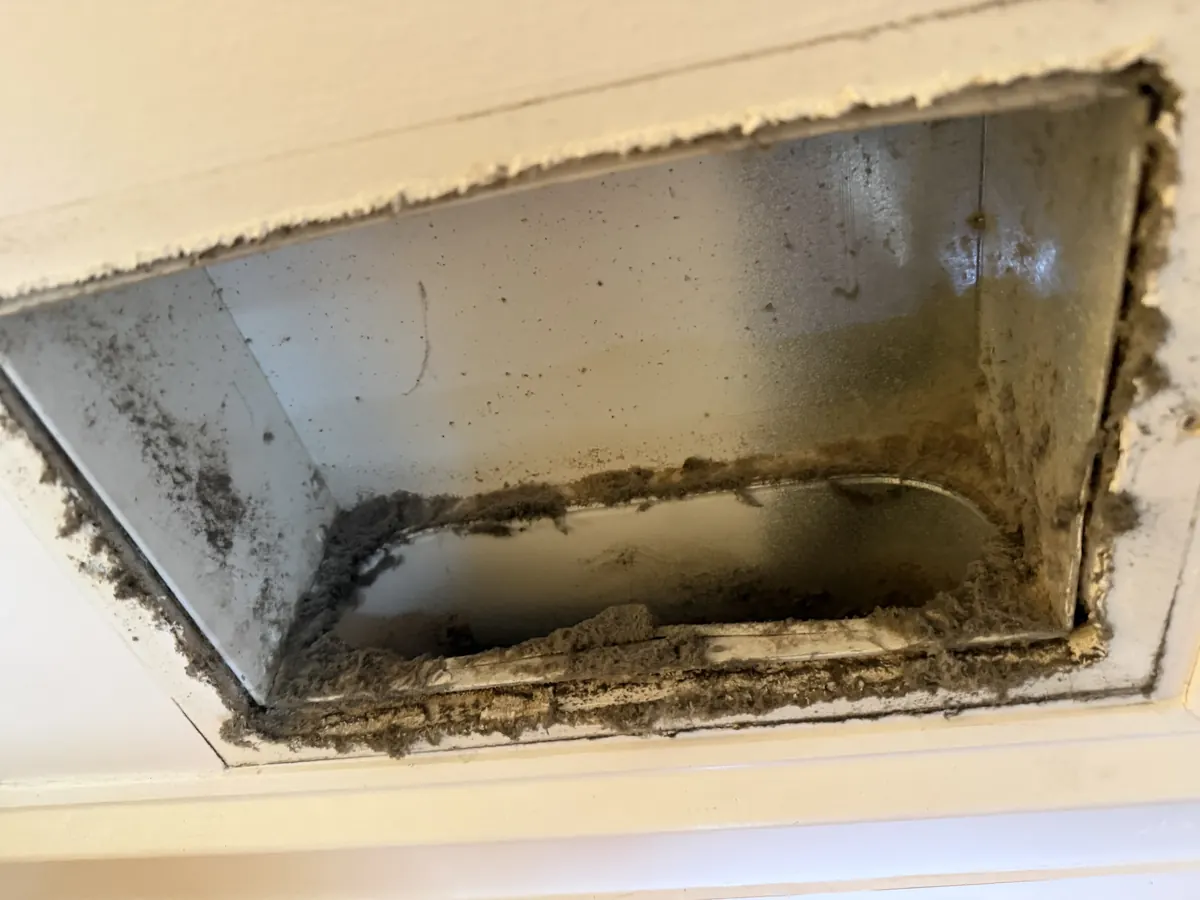
A technician opening up a panned return for Air Duct Repair, or running a camera and brush through one for Air Duct Cleaning, is often the first person in years to see inside that cavity. A gas line crossing the bay shows up as a straight run of black iron or flexible connector passing through sheet metal that was never built to accommodate it, sometimes with a visible gap or crimp where the duct panning was cut to let the pipe through. That cut is itself a problem independent of the gas line, since it leaves an opening in the return path that pulls unconditioned basement or crawlspace air into the system. Finding the line is the point where the job stops being just duct work and becomes a call to a plumber or heating contractor who handles gas piping, since moving the line is outside the scope of duct cleaning or duct repair.
What happens once the line has moved
After the gas line is rerouted out of the cavity, the duct side of the job is straightforward. The openings cut into the panning for the old line get sealed, and if the panned bay has enough other damage, cracked seams, gaps at the joist bottoms, sections that were never properly closed, the better fix is often replacing that stretch of panned return with real sheet metal or rigid duct rather than patching sheet metal that was compromised more than once. A written estimate for that kind of work spells out whether the job is a seal-and-patch or a section replacement, based on how much of the panning is still sound once the gas line is out of the way.
Sources
- U.S. Census Bureau, American Community Survey 2020 to 2024, year structure built, Cherry Hill township (Census Reporter)
- U.S. Census Bureau, American Community Survey 2020 to 2024, house heating fuel, Haddonfield, Collingswood and Haddon Heights boroughs (Census Reporter)
- EPA: Carbon Monoxide's Impact on Indoor Air Quality