Dryer Vent Installation in Cherry Hill, NJ
Dryer vent installation replaces a run that was built wrong, or builds a new one when the laundry moves. The standard is rigid metal on the shortest route the house allows, joined without screws poking into the airflow, and ending at an outside cap with a damper and no screen.
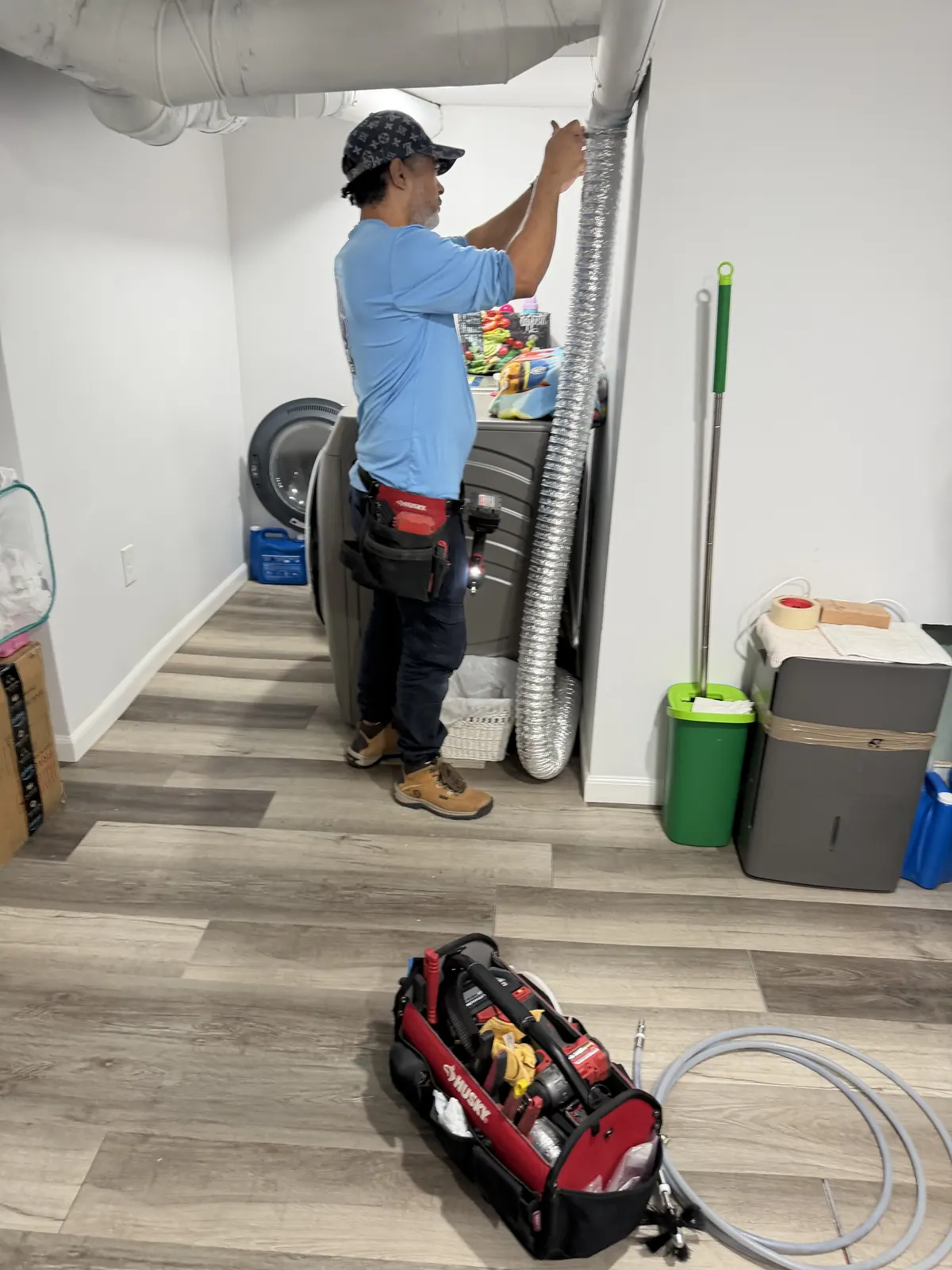
Laundry rooms move. In Cherry Hill's postwar houses the dryer usually started out in the basement or on the bottom floor of a split-level, and remodels bring it up to a mudroom off the kitchen or a closet on the bedroom floor of a colonial. The dryer moves easily. Its exhaust does not, and a new location that is two floors and a hallway away from an outside wall is a vent problem before it is anything else. Townhomes and condos in Voorhees, Mount Laurel, Evesham and Maple Shade add their own limits, with shared walls on both sides and association rules about what can go through the roof.
The rules are clear. New Jersey's residential code, which follows the International Residential Code, calls for a dryer exhaust that is independent of every other system and carries the moisture outdoors, metal duct with a smooth interior, no screws or fasteners reaching into the duct beyond a small allowance, a transition hose listed for the job and never concealed inside the walls, and a termination with a backdraft damper and no screen. The dryer's own installation instructions set the length limit for that model. The U.S. Fire Administration's advice to owners starts with having the dryer installed by a professional.
What does a correct dryer vent look like?
A correct run is rigid, smooth-walled metal in the diameter the dryer's listing calls for, with every joint lapped so the upstream piece slides inside the downstream one and the lint rides over the seam instead of catching on it. Joints are sealed with foil tape rather than screws. The duct carries dryer exhaust and nothing else; a bathroom fan or a range hood is never tied into it. The run is strapped along its length so it cannot sag, and where it passes through an attic, a garage or a crawl space it is insulated so warm, wet exhaust does not condense inside it and turn the lint into paste.
Behind the dryer, a short listed transition connector links the machine to the wall and stays exposed where it can be checked and replaced. A recessed dryer box in the wall lets the machine sit closer without crushing that connector. Outside, the run ends at a cap whose damper swings open when the dryer runs and falls shut against wind and birds when it stops. A louvered cap with a screen, or a roof vent borrowed from a bathroom fan, is the wrong part for a dryer.
How is a route chosen when the laundry moves?
The shortest path to outside air wins, even when it is not the prettiest. From a second-floor closet in a colonial, that often means through the nearest exterior wall, or up into the attic and out a gable wall, rather than down two floors to the old basement exit. From a first-floor mudroom in a ranch, a side wall a few feet away beats a run under the floor to the back of the house. Every elbow counts against the dryer's allowed length, so the route is drawn to use as few as the framing permits.
When no route stays within the limit, a booster fan listed for dryer exhaust is the fallback, not the plan. It has to be sized for the run, it adds a part that needs cleaning and attention, and it cannot fix a route that was badly chosen. The crew measures the run and counts the turns during the estimate, reads the limit for your dryer's make and model, and tells you whether the planned laundry spot works before the plumber and the cabinet maker have committed to it.
What about townhomes, condos and older houses?
Attached homes leave fewer choices. In an interior unit, party walls rule out side exits, so the run often goes to the front or back wall or up through the roof with a cap made for dryer exhaust. A roof penetration in an association community usually needs written approval and flashing done to a roofer's standard, and the crew asks about both when the visit is booked. Where a unit's laundry sits on an interior wall, the run crosses the ceiling to the nearest outside wall the association allows, and that path is sketched with you before the estimate is written. Replacing a run in an older unit can turn up foil or plastic duct hidden in a ceiling, which the code does not allow inside the construction, and that section comes out entirely.
Haddonfield's historic district treats a new vent hood on a street-facing wall as a change to the building's exterior, which the borough's preservation commission reviews through a Certificate of Appropriateness, so the hood's location is chosen with that review in mind. Older houses in Collingswood and Haddon Heights may have brick or stone foundation walls, which take different tools and more time to pass through than a wood rim joist, and the estimate reflects that.
How is an installation priced and booked?
The estimate is free and is given after the crew has seen where the dryer is going and where the air can get out. It covers the route, the material, the number of elbows, the wall or roof exit and any association or borough approval that has to come first. Veteran owned and licensed and insured under NJ HIC 13VH13654300, AMG Duct Cleaning Cherry Hill can be reached 8 AM to 8 PM, Monday to Saturday to set the visit.
New vent runs go into houses in Cherry Hill and in Voorhees, Mount Laurel, Evesham, Maple Shade, Haddonfield and Collingswood, among other towns close by. Once the new run is in, openings cut for it are closed, the work area is vacuumed, and the dryer is reconnected and run while airflow is checked at the cap. A new vent still collects lint, so the crew suggests when to book the first dryer vent cleaning, and when the laundry move is one piece of a bigger remodel, the heating and cooling for the remodeled rooms can be handled through air duct installation at the same time.
What is included
- A route planned for the shortest run and fewest elbows the house allows
- Rigid, smooth-walled metal duct in the size the dryer's listing calls for
- Joints lapped in the direction of airflow and sealed with foil tape
- No screws reaching into the airflow
- A listed transition connector, left exposed behind the dryer
- Straps along the run and insulation through cold spaces
- An outside cap with a backdraft damper and no screen
- A test run with airflow checked at the cap
Questions and answers
Can a townhome dryer vent go out through the roof?
Yes, when no wall exit works. The run needs a cap made for dryer exhaust, not a bathroom fan vent, and most associations need to approve the roof work first. A roof exit also collects lint faster, so it should be cleaned more often than a wall vent.
How long can a dryer vent run be?
As long as the dryer's installation instructions allow for that model, with each elbow using up part of the allowance. New Jersey's residential code sets default limits as well. A run longer than the limit needs a booster fan listed for dryer exhaust, or a better route.
Is flexible foil duct allowed for a dryer vent?
Only as the short listed transition connector behind the dryer, and never hidden inside a wall or ceiling. The run itself should be rigid metal with a smooth interior. Foil or plastic found inside the framing is replaced.
Do I need a booster fan for my dryer vent?
Only if no route stays within the length the dryer allows. The fan must be listed for dryer exhaust and sized for the run, and it has to be cleaned along with the vent. A shorter route is always tried first.
How much does dryer vent installation cost in Cherry Hill?
It depends on the route, the length, what the wall is made of and whether the exit is a wall or a roof. A short run through a wood rim joist is a small job compared with a second-floor laundry venting through an attic. The estimate is free and is given on site.
More questions and answers about our work
Dryer Vent Installation across South Jersey
We provide dryer vent installation in South Jersey. Choose your town for local details.
Ready for cleaner air?
Tell us about your home and get a free estimate.