Cherry Hill is the suburb the postwar boom built. The township roughly tripled its population across the 1950s and doubled it over the 1960s, its master plan counts more than seven in ten of its homes as built between 1940 and 1980, and Census estimates date more of its houses to the 1960s than to any other ten-year stretch. By now many of them have replaced the original furnace, while the ductwork in a good share is still what the builder installed. So the question homeowners here ask most is a fair one: does ductwork from the 1960s want cleaning, repair, or both, and in which order?
What a house from the boom years started with
A ranch, split-level or colonial from that era was usually built with a furnace in the basement or a ground-floor utility room, a rectangular sheet metal trunk running across the joists, and round branch runs teeing off to each room. Joints were fastened with screws and wrapped in cloth-backed tape. The return side was often cheaper than the supply side: instead of a full duct, builders closed off a joist bay or a stud cavity with a sheet of metal and used the framing itself as the air path.
That design worked when it was new and tight. Decades later the furnace and the air conditioner have been replaced, a basement has probably been finished, and a kitchen or a family room may have been added. The sheet metal is usually still sound. What has changed is everything connected to it.
Where decades of use show up
The first failures are at the joints. Cloth tape dries, shrinks and lets go, and a seam that leaked a little when the house was new leaks a lot now. Boots, the fittings where a branch meets the floor register, pull away from the subfloor as the house settles. Panned returns leak along every edge where the metal meets the wood. Flexible runs added during later remodels get crushed above finished ceilings or pulled off their collars by whoever worked nearby.
Water adds its own wear. Cherry Hill sits between the Cooper River and the creek that marks its Burlington County line, and the U.S. Geological Survey's report on the July 2004 storm records nearly eight inches of rain in the township. A basement that took water then, or one that runs damp every August, tends to show rust on the boots and the bottom of the trunk, and a musty smell when the cooling starts.
Why sealing comes before cleaning
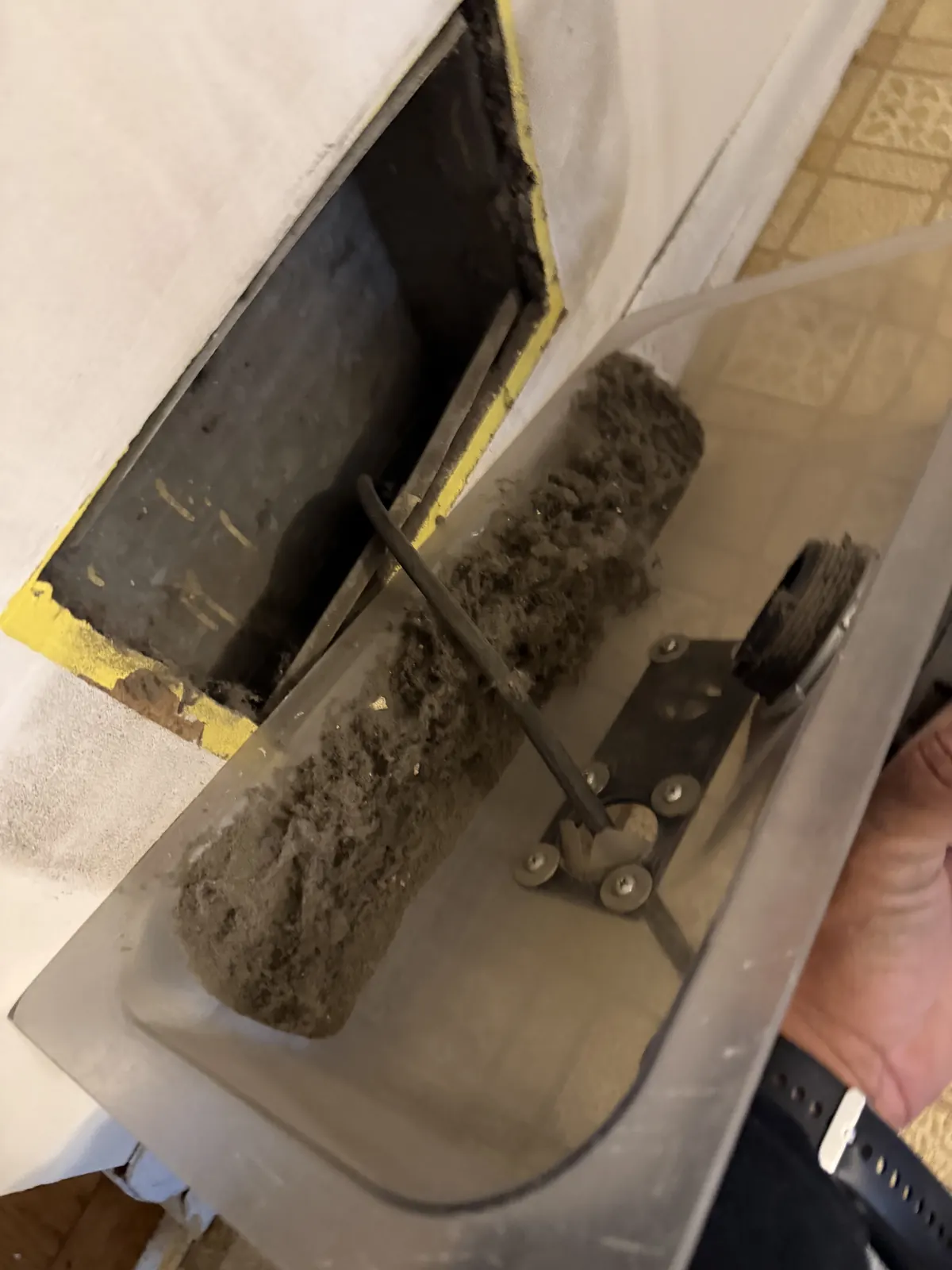
A leak on the return side matters more than it looks. Every time the blower runs, it pulls air from wherever the return is open: the basement, the crawl space, the wall cavity behind a panned return. That air carries whatever is there, from dust and insulation fiber to the dampness of an unfinished basement. Clean the ducts without closing those leaks and the system starts loading itself again the next week.
So in a house this age, air duct repair usually comes first. That means sealing seams and panned returns with mastic, reattaching and sealing boots, and replacing flexible runs that are crushed or torn. Once the system holds its air, air duct cleaning removes what the leaks pulled in over the years, and the result lasts.
When cleaning is the right call
The Environmental Protection Agency's guidance is a good yardstick. The agency lists three situations that justify a cleaning: visible mold inside hard ducts or on parts of the heating and cooling equipment, an infestation of mice or insects, and a load of dust and debris heavy enough to clog the ducts or puff out of the supply registers. It also notes that duct cleaning has not been proven to prevent health problems, and we hold to that.
In Cherry Hill those conditions tend to follow events: a renovation that ran the system while drywall was being sanded, a move into a house whose history is unknown, a pet household, or a damp basement that let growth start at the coil. Where growth has taken hold, mold treatment and removal handles it on the ductwork, the coil and the blower cabinet after the dampness is fixed.
When repair or new duct makes more sense
Some problems no cleaning can reach. A bedroom that never warms up is usually fed by the last branch on a long run, and that branch is often flattened or has come loose from its collar. A finished basement or an addition that was tapped off the nearest run starves the rooms beyond it. A second floor with one return in the hallway pulls its air under closed doors. These are air duct repair jobs when the existing duct can be restored, and air duct installation jobs when a run is beyond saving or a room never had proper supply or return.
Replacing a whole system is rarely the answer in these houses. The trunk and most branches are heavy gauge metal that will outlast the next several furnaces. The work is almost always targeted: seal what leaks, replace what is crushed, add what is missing.
What a Cherry Hill visit covers, in order
A good visit starts with a walk-through before anything is quoted. We look at the air handler and the filter slot, trace the return path, open a few registers to see the boots and the branches, and check the dryer run and any flue while we are there. If the return leaks, that goes to the top of the list. If the ducts are loaded with debris, the cleaning follows the sealing. You see the photographs and the findings, and the estimate reflects the house rather than a flat package.
A few details make that first hour more useful: the age of the furnace and the air conditioner, whether the basement has ever taken water, which rooms run hot or cold, and what has been renovated since the house was built. Those answers point to the branches worth opening first.
Neighbors across the Cooper River in Haddonfield and Collingswood live with older houses and different problems, and townhouse owners in Voorhees have their own. But for the postwar ranch, split-level or colonial that makes up so much of Cherry Hill, the order holds: seal and reconnect with air duct repair first, then clean, and add new duct only where a run is gone or a room was never served.
Sources
- EPA guidance on residential air duct cleaning
- Cherry Hill Township, 2018 Master Plan, Chapter 2: Demographics
- U.S. Census Bureau, American Community Survey 2020 to 2024, year structure built, Cherry Hill township (Census Reporter)
- U.S. Geological Survey, Flood of July 12 and 13, 2004, Burlington and Camden Counties, South-Central New Jersey (Scientific Investigations Report 2006-5096)