A cup of coffee, a knocked-over vase, a cat that got sick on the way to the litter box: liquid down a floor register is a call we get through most of the year in Cherry Hill, a township where census estimates still date more of the housing stock to the 1960s than to any other decade. Those houses were built with a basement trunk line and round branch ducts running under the floor to each room, and the boot, the metal fitting where the branch turns up to meet the register, sits right where the spill lands. What happens after that depends less on how much went down the opening and more on what the duct below it is made of.
Shut the system off before you clean anything
The first move is the blower, not the mop. If the furnace or air handler fan comes on while liquid is sitting in the boot or the branch, it pulls that moisture and whatever is in it further along the run, and it can push a smell into other rooms through the supply side. Switch the thermostat fan setting off, or the system off if it is easy to reach, then pull the register cover and look down with a flashlight. Blot what you can reach with a towel wrapped around a straight tool, and let the opening sit uncovered for a while so air can dry the metal instead of trapping the moisture behind a closed register.
Bare metal dries and cleans, lined duct does not
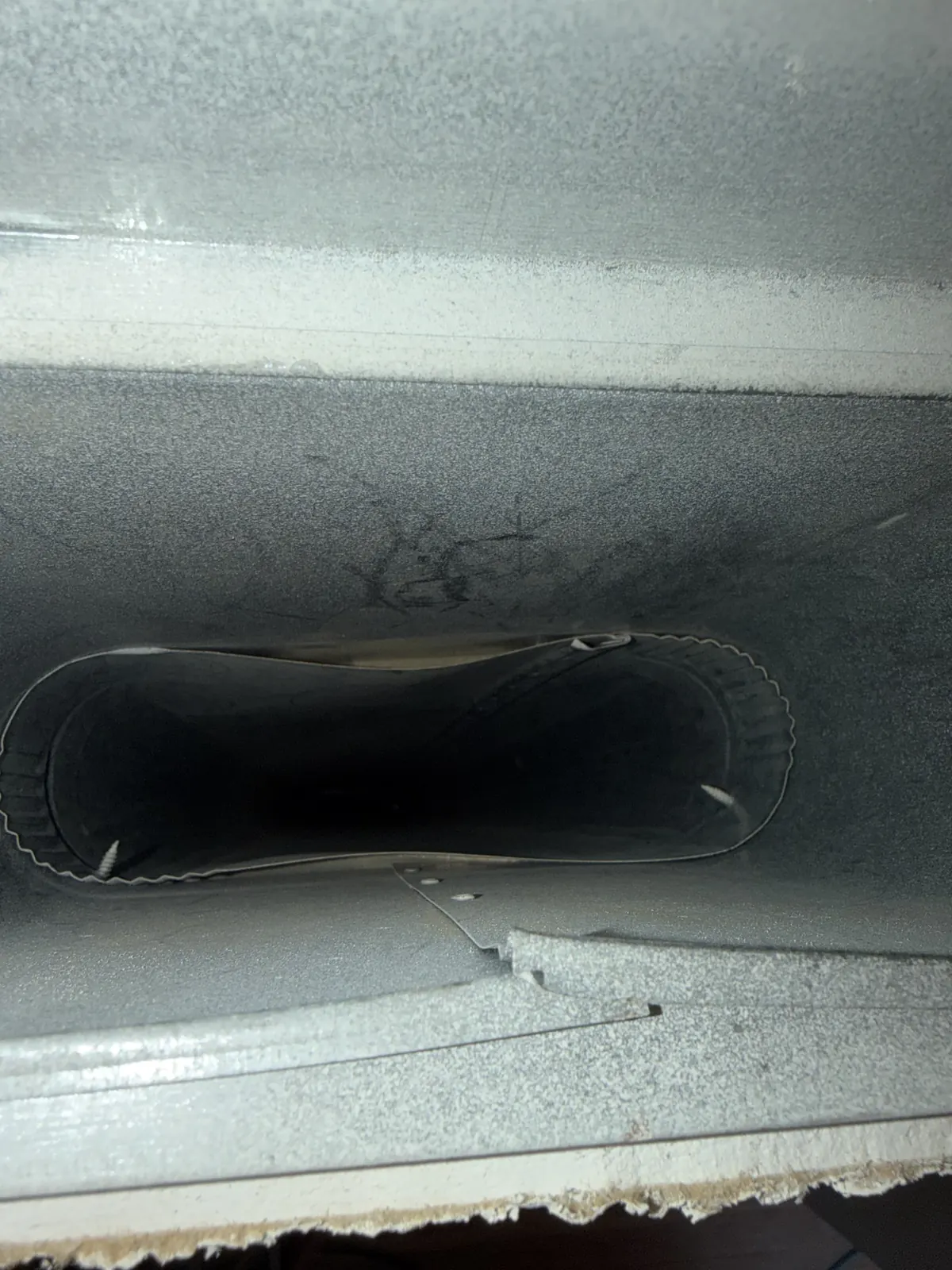
This is the fact that decides everything. The EPA's guidance on residential duct cleaning states plainly that duct insulation that becomes wet cannot be cleaned effectively and should be removed and replaced. A basement trunk and most branch runs in a 1960s Cherry Hill house are bare galvanized sheet metal, and bare metal can be wiped, dried and cleaned the way any other hard surface can. But some runs, especially ones that pass through an unconditioned crawl space or an attic, use flexible duct with a fibrous insulation sleeve, or the plenum near the furnace may be lined with fiberglass board. If liquid reaches one of those sections, drying it out does not put it back to where it started. That section comes out.
So the question is never just how much spilled. It is what kind of duct sits under that particular register, and that is something worth checking before deciding whether a cleaning will settle it or whether a piece of Air Duct Repair is coming next.
How far a spill travels
A small splash, a few ounces of coffee or juice, usually stays in the boot. The boot sits below the level of the subfloor and acts like a shallow cup, and most of what lands there either evaporates or gets caught with a towel in the first few minutes. A larger spill, a full glass, a bowl of pet food and water knocked over, or a sustained accident from a sick pet, behaves differently. It runs down the slope of the branch toward the trunk, pools at the low point of any seam, and can travel several feet before it stops moving. On a long branch feeding a bedroom at the far end of the house, that means the mess is not confined to the register where it was poured in. It is worth checking the boot at the trunk connection too, not just the one under the spill.
Pet accidents and cleaning water carry their own residue
Pet urine and vomit are the accidents that come back to us most, because a floor register at carpet or tile level looks like an open spot to a cat or a dog under the couch. The liquid itself dries, but the residue it leaves behind, especially in a porous liner, holds an odor long after the surface looks clean. Mop water and carpet cleaner run into registers just as often, usually during a floor cleaning day when nobody was watching where the water was flowing. Both cases follow the same rule as any other spill: bare metal in the boot and branch gets wiped, rinsed if needed, and dried, while a section that has fibrous insulation soaked through it gets cut out rather than scrubbed.
When the smell will not let go
A boot that was dried and wiped down should not carry a lingering odor once the surface is clean. If a smell keeps coming back through that register weeks later, especially with pet accidents, the residue has usually worked its way into something the towel could not reach: a seam that trapped liquid, a section of liner, or a low point in the branch that never fully dried. That is the point where cleaning has done what it can and the fix is mechanical rather than chemical, opening the duct at the boot or cutting into the branch to remove and replace the affected piece.
What we look at on a Cherry Hill visit
On a call like this we start at the register, pull the boot if it comes out easily, and follow the branch back toward the trunk with a camera or a flashlight to see how far the liquid traveled and whether the duct along the way is bare metal or lined. Where it is bare metal, Air Duct Cleaning handles it, working the branch and boot with a brush and vacuum until the residue and any leftover odor source are gone. Where a section is insulated flex or the plenum liner itself got wet, that piece is cut out and replaced under Air Duct Repair, and if the branch was already weak or crushed before the spill, a full run may go in fresh rather than being patched. Homes in Haddonfield and Voorhees see the same split, since both older and newer construction mix bare trunk with insulated branch runs depending on where the duct passes through unconditioned space. Either way, the call is made at the duct, not guessed at from the register cover, and the estimate reflects what that particular run turns out to need.