Townhouses are a big part of the housing on the Burlington County side of Cherry Hill. Census estimates count a quarter of Mount Laurel's homes as townhouses or other attached units, and about one in five in Evesham, and both townships did most of their building from the 1970s through the 1990s, a stretch in which Mount Laurel's housing more than doubled in a single decade. The complaint is a familiar one: the dryer used to finish a load in one cycle and now takes two. In a townhouse, the reason is usually the vent, and the vent in a townhouse is a harder run than the one in a detached house.
Why a townhouse dryer vent runs so far
A detached house can send its dryer duct out whichever wall is closest. A townhouse has neighbors on one or both sides, so it may have only a front and a back wall to work with, and the laundry closet is often on the bedroom floor, in the middle of the unit. The duct then has two choices. It rises through the attic to a roof termination, or it runs sideways above a ceiling until it reaches an exterior wall. Either way it is long, it turns several times, and part of it runs through space nobody sees.
Every turn adds resistance, and every foot of duct adds more. Dryer makers publish a maximum exhaust length in their installation instructions and subtract length for each elbow, and many upstairs townhouse runs sit close to that limit on the day they are built.
Where the lint collects
Lint that gets past the screen travels until the air slows down, and in a long run the air slows down in predictable places. It gathers in the flexible hose behind the machine, at each elbow, and in the vertical rise to the roof, where it falls back down every time the dryer stops. At the top, a screen on the roof cap or a flap that sticks catches the rest. In an unconditioned attic the warm, damp exhaust can also cool enough to condense, which turns loose lint into a paste that clings to the pipe.
The warning signs the CPSC points to
The Consumer Product Safety Commission warns that lint collecting inside the dryer or along its exhaust duct can choke the airflow, build up heat and, in some dryers, start a fire. Its first warning sign is the one townhouse owners notice: clothes that come out damp after a typical cycle, or drying that takes longer than it used to. The commission also suggests going outside while the dryer is running to confirm air is leaving the vent. On a roof termination that is hard to do from the ground, so a hot, humid laundry closet is often the more practical clue.
The National Fire Protection Association adds a schedule: its tip sheet says to have lint cleaned from the vent pipe every year, and sooner whenever drying times stretch. A long roof run in a busy household can reach that point well before the year is out.
Foil, plastic and the hose behind the machine
The short connector between the dryer and the wall deserves its own look. The CPSC's advice is to swap plastic or foil accordion ducting for rigid or corrugated semi-rigid metal, because the flexible plastic and foil types trap lint more easily and kink or crush more readily. In a laundry closet, where the machine is shoved back so the doors will close, a foil connector is often flattened behind it without anyone knowing. Swapping it is a small job that removes one of the worst restrictions in the run.
The CPSC's list covers the dryer too: empty the lint screen with every load, vacuum the floor and wall behind the machine where stray lint piles up, and now and then have a service technician open the cabinet and clear out what has built up inside. Lint that slips past the screen settles in the cabinet as well as in the duct.
Cleaning a roof run from inside the unit
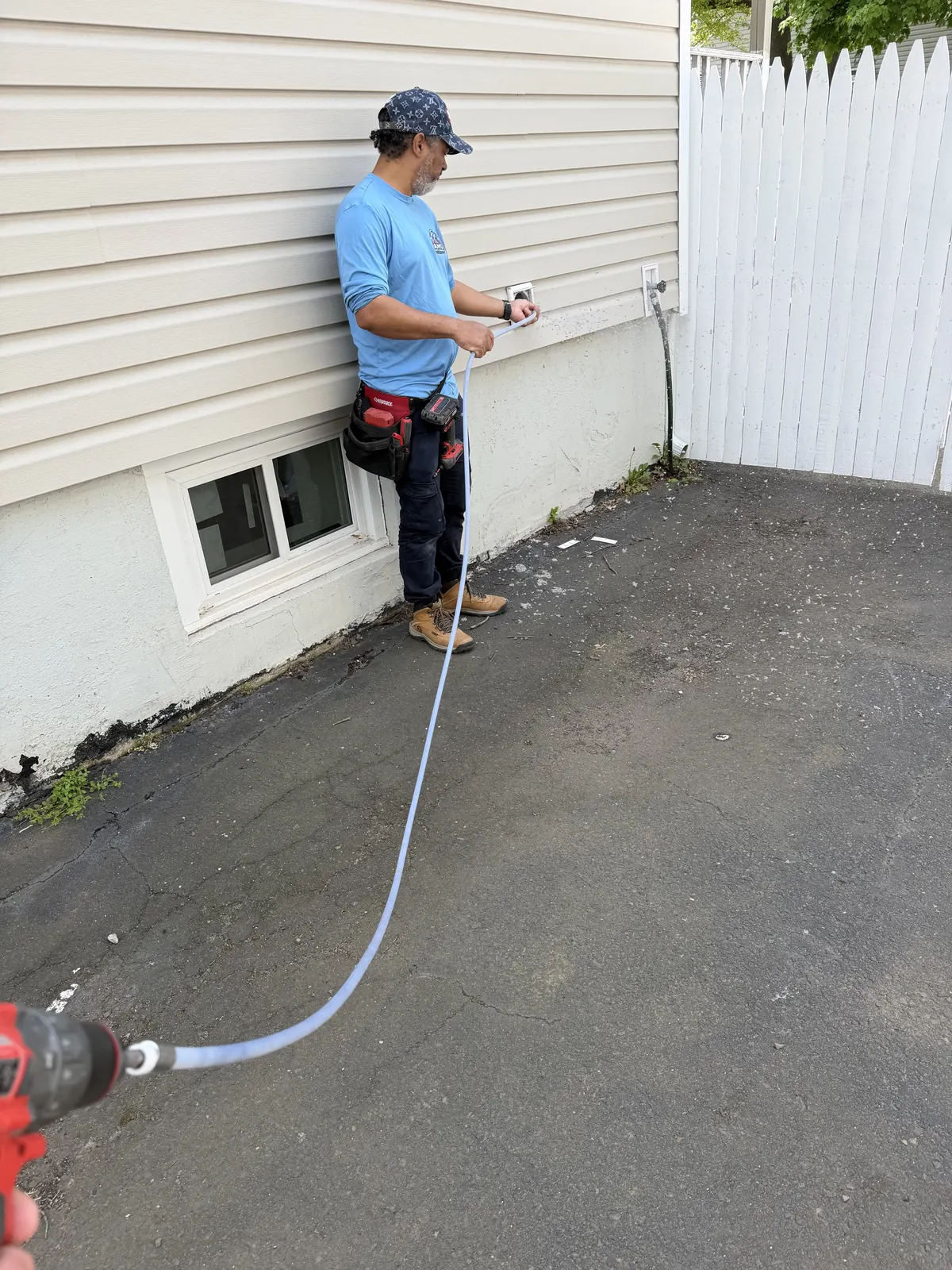
Most of a roof run can be cleaned from the laundry side. We disconnect the dryer, run a rotary brush and airflow up through the duct to the termination, and pull the lint back out through the bottom. Then we check that air moves at the cap with the dryer running. Where the cap itself is clogged, screened or packed with a bird's nest, it has to be reached from the roof, and on a townhouse that usually means the association's say-so first.
Dryer vent cleaning on a sideways run over a ceiling works the same way from the dryer end to the wall hood, with the hood and its flap cleaned and tested from outside.
When the run itself is the problem
Some runs clog again quickly however well they are cleaned, because the route is the problem: too long for the dryer, too many turns, a section that sags in the attic, or duct that was crushed during a roof repair. That calls for dryer vent installation rather than another cleaning. A rebuilt run uses smooth rigid metal, the fewest turns the building allows, joints taped with foil tape instead of fastened with screws that catch lint, and a termination with a working flap. In a townhouse the shortest route sometimes means changing where the vent exits, which brings the association back into the conversation.
Working with the association
In most Mount Laurel and Evesham townhouse communities, the roof and the outside walls belong to the association, while the dryer and the duct inside the unit belong to the owner. That split decides who approves what. Cleaning from inside usually takes nothing more than a booking. Roof access, a new cap or a new exit through a wall usually has to be signed off by the management office, and many offices ask for paperwork before a contractor sets foot on a common roof. Sending the community's rules with the booking lets the visit happen once instead of twice.
For most owners the sequence is simple enough: dryer vent cleaning from the laundry side, a look at the cap, and a replacement connector if the old one is foil. Where the run is beyond cleaning, dryer vent installation gives it a shorter, smoother path, and the dryer goes back to finishing a load in one cycle.
Sources
- U.S. Consumer Product Safety Commission, dryer fire safety alert (Publication 5022)
- NFPA tip sheet on clothes dryer safety
- U.S. Census Bureau, American Community Survey 2020 to 2024, units in structure, Mount Laurel and Evesham townships (Census Reporter)
- U.S. Census Bureau, American Community Survey 2020 to 2024, year structure built, Mount Laurel and Evesham townships (Census Reporter)
- Township of Mount Laurel, Fourth Round Housing Element and Fair Share Plan, June 12, 2025