It can. A clothes dryer does not only blow warm air out of the house, it pulls an equal volume of air out through its exhaust duct, and that air has to come from somewhere inside the room. In an open basement with a door that clears the floor by an inch, replacement air slides in around the frame and nobody notices the pull. In a small laundry closet built as its own enclosed space, the kind found in plenty of Cherry Hill and Pennsauken homes where the washer, dryer and gas water heater share one tight room, that same pull can draw harder than the closet can replace air for, and the water heater's draft hood becomes the next path of least resistance, except what it gives up is flue gas headed the wrong direction.
Why the water heater is the weak point
A standard atmospheric gas water heater has no fan pushing exhaust up the flue. It depends on natural draft, warm combustion gases rising through a draft hood and up a vent pipe because they are lighter than the air around them. That lift is gentle, built for a room sitting at roughly the same pressure as the rest of the house. A dryer running nearby in a closed room can drop that room's pressure enough to overwhelm the lift, and once the closet is at lower pressure than the flue, air reverses right at the hood opening, pulling flue gas into the room instead of letting it rise.
Why a small closed room makes it worse
A larger furnace room has more air volume to draw from and a door that rarely closes tight, so the dryer and the water heater have room to sit without depressurizing much. A laundry closet built as its own small space, maybe added during a renovation with the dryer stacked a few feet from the tank, holds a small volume of air that closes off faster once the dryer starts pulling. A tight-fitting door on that closet makes it worse still, since little air can slip in around the frame to replace what the dryer is sending outside, which is the opposite of what the room's gas appliance needs to keep its flue drawing upward.
What a heating technician tests
The test is straightforward. With the dryer running a full cycle and the laundry room door shut the way it normally sits, a technician checks the draft right at the water heater's hood, watching a lit match, a smoke pencil, or the behavior of the pilot flame at the gap where the hood meets the flue connector. Smoke or flame drawn into the hood instead of drifting up and away is spillage, the sign that combustion gases are not clearing the hood the way the appliance was designed to let them. New Jersey's fuel gas provisions call for makeup air to be supplied where a dryer or an exhaust fan interferes with a fuel-burning appliance's draft, and this hood test is how that interference gets confirmed before anyone recommends a fix.
What fixes the pull
The code answer is makeup air, a louvered door, a transfer grille cut into an adjacent wall, or a dedicated duct bringing in outside or adjacent-room air sized for what the dryer removes. One major dryer maker goes further and states that no other fuel-burning appliance should share the same closet as a dryer at all, which points toward relocating the water heater or the dryer rather than trying to make the shared closet work with ventilation alone. A sealed-combustion or power-vent water heater removes the problem at its source, since that kind of unit draws its own combustion air through a dedicated pipe and exhausts mechanically rather than depending on room pressure and a passive draft hood. Which path makes sense for a given closet, a bigger opening, a relocated appliance, or a different water heater, is a call for the plumber or HVAC contractor who services the appliance, since it is their equipment and their code section governing the install.
Keeping the dryer side of the problem small
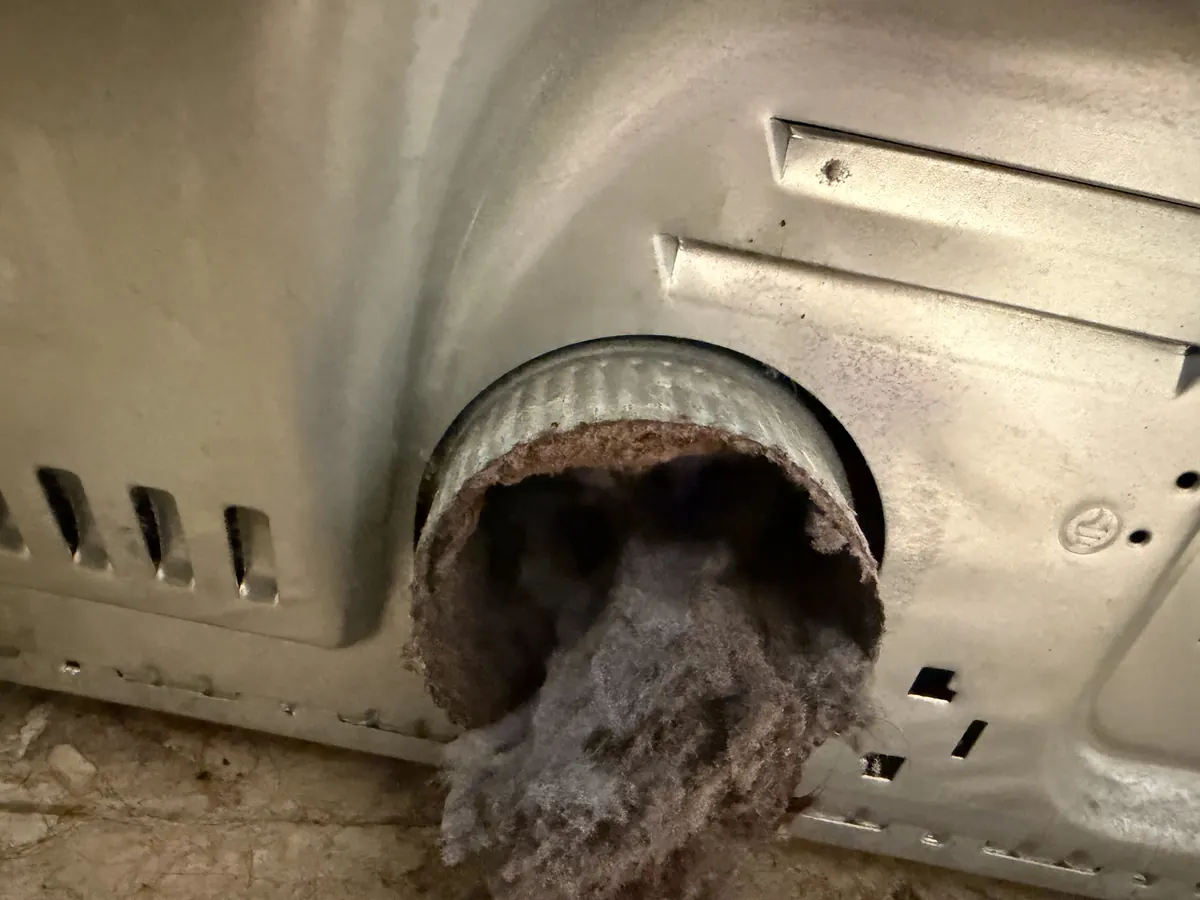
A dryer fighting a long, clogged or crushed vent run has to pull harder to move the same volume of exhaust, which means it draws more room air to replace it and makes the depressurization worse in a tight closet. Keeping that duct clean and the path short and smooth is what Dryer Vent Cleaning and a correctly sized Dryer Vent Installation take care of, and in a shared closet in Cherry Hill or Pennsauken that housekeeping matters more than it would in an open basement, because there is less room for the dryer to spare. A dryer venting through a long run to a roof cap, or through a duct that has not been cleaned in some time, is working harder than it needs to, and that extra draw adds to whatever pressure problem the closet already has.
Carbon monoxide alarms as the backstop
None of this is a substitute for carbon monoxide alarms placed on every level of the home and outside sleeping areas, tested on a regular schedule. If an alarm sounds, the right response is to get everyone outside and call for help before trying to find the source, since carbon monoxide has no smell or color to warn anyone working near the appliance. A laundry closet that shares space with a gas water heater is exactly the kind of room where an alarm earns its place nearby.